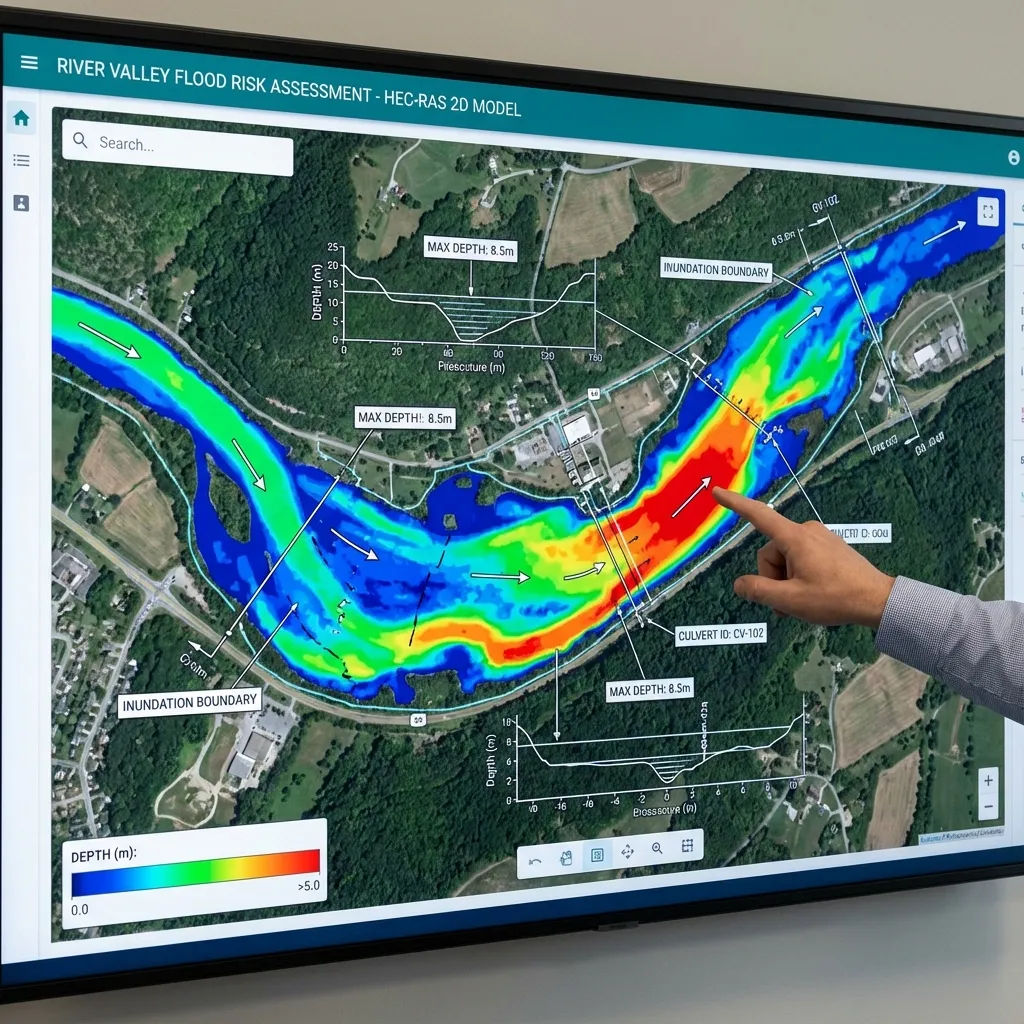
Calling a flood a hundred-year event does not mean that another event of the same size cannot happen for a hundred years. The term describes the statistical frequency of a specified magnitude. Owners need to consider that probability alongside service life and potential damage. Reports should identify the return period, calculated discharge and observation period together; the number alone establishes neither safety nor regulatory acceptance.
Return period and annual exceedance probability
Under stationary statistical assumptions, a T-year return period corresponds to annual exceedance probability p = 1/T. The probabilities are 2% for a 50-year magnitude, 1% for a 100-year magnitude and 0.2% for a 500-year magnitude. Exceedance means reaching or exceeding that threshold. It may occur in consecutive years. Reporting annual exceedance probability beside the return period helps prevent the mistaken interpretation of a fixed calendar interval.
Probability over a structure's service life
If annual events are independent and probability remains constant, the chance of at least one exceedance in N years is 1 − (1 − p)^N. For a 1% annual threshold over thirty years, it is approximately 26%. This is not a parcel's damage probability: it describes exceedance of the chosen flood magnitude. Actual damage also depends on location, ground elevation, use, protection, depth and velocity. Reports should keep threshold exceedance and damage probability distinct.
Selecting the assessment return periods
Choose assessment periods according to function, consequences of failure or overtopping, study purpose and project-specific authority requirements. A single period does not suit every structure. Temporary road closure and flooding of a critical facility have different consequences. Examining more frequent and rarer events alongside the principal scenario reveals where a proposed solution becomes inadequate. Document the selection rationale, and do not present a period used in an example as a universal regulatory requirement.
Record length and changing catchment conditions
Return-period discharges are estimates based on records and statistical methods, rather than fixed directly measured quantities. Short series, gaps, measurement changes and outlier treatment affect the estimates. Urbanisation, drainage alterations and climate changes may weaken the relevance of historical records. Check station suitability and observation periods. Uncertainty ranges or sensitivity analysis may communicate the evidence better than a single apparently exact value. A long return period does not imply high estimation accuracy, especially for rare events.
Questions for the project owner
Ask which return periods were calculated and why, then check the data and methods behind the discharges, their hydraulic-model application and the site elevations used for comparison. Identify how rarer events change access, basement entry or the performance of existing structures. Revised building locations, fill, bridge openings or impervious cover may require reassessment. The purpose of these questions is to expose the chain of evidence and scenarios behind a decision, rather than simply look for a large return-period number. State independence and stationarity assumptions to define the lifetime-probability calculation’s validity.
Translating results into project decisions
A project owner should receive more than a coloured map. The report should bring together the data inventory, survey date, horizontal and vertical reference systems, method used to obtain discharges, scenarios examined and limits of the model domain. Legends, scales, scenario names and elevation references make maps easier to compare with architectural or infrastructure drawings. Calculations should explain the reasoning behind a decision and identify the assumptions whose revision would require the results to be reconsidered.
At quotation stage, share the study boundary, structure type, available surveys and expected deliverable files. These details help define the scope and additional data requirements. Discharges, elevations or design approaches taken from another project should not be transferred directly to this site. The competent authority's project-specific requirements are checked separately. A flood assessment does not guarantee that no future event will occur; it provides an engineering basis for understanding risk and comparing mitigation options under the selected data and scenarios.
Sources and related articles
Let's discuss your project's data requirements and reporting scope.
Request a project quote