Normal and critical depth answer different questions. Normal depth conveys flow under uniform conditions; critical depth corresponds to minimum specific energy for a given flow and section. Actual water surfaces need not equal either everywhere. A simple section calculation does not replace a reach profile. Assess regime and upstream/downstream controls together.
Normal depth from Manning
In SI, Manning is Q = (1/n) A R^(2/3) S^(1/2), with wet area A, hydraulic radius R = A/P, wetted perimeter P and friction slope S. Explain the uniform-flow slope assumption. ArchSu iteratively calculates normal depth for rectangular/trapezoidal sections and V = Q/A. This does not include bridge backwater, downstream controls or abrupt transitions.
The energy meaning of critical depth
Specific energy combines depth and velocity head relative to the bed. At fixed discharge, changing depth changes velocity and creates an energy minimum: critical flow. For rectangular width b and q = Q/b, yc = (q²/g)^(1/3). This special relation is not directly valid for trapezoidal or irregular sections. Detailed analysis also considers energy assumptions and velocity-distribution corrections.
Flow regimes through Froude number
For simple channels, Fr = V/√(gD), with hydraulic depth D = A/T and surface width T. D is not hydraulic radius R. Fr below one indicates subcritical and above one supercritical flow; near one is critical. Account for irregular-section definitions. Regime helps identify control direction and jumps. Near the threshold, consider precision and physics rather than classify rounded values definitively.
A rectangular-section example
For illustrative Q = 2 m³/s and b = 2 m, q = 1 m²/s; with g = 9.81 m/s², yc ≈ 0.467 m. Normal depth additionally requires roughness and slope and may be larger or smaller. These numbers demonstrate differing inputs, not recommended dimensions. Real designs check profiles, regime transitions, freeboard and lining resistance together.
When a simple calculation is insufficient
Structures, constrictions, bed changes and high downstream levels can invalidate uniform-flow assumptions. Time-varying flow and floodplains may require fuller modelling. Do not apply normal depth as a universal water elevation. Preserve units and physical input constraints. State simplifications, omitted effects and further checks so preliminary calculations support comparisons without false certainty.
Connecting design with construction and maintenance
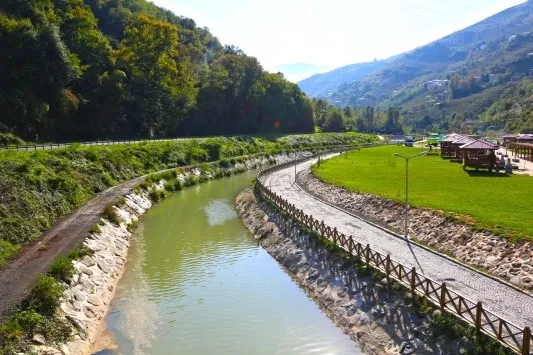
A river-rehabilitation assessment does not end with the calculated cross-sectional area. Transitions, existing structures, access, material properties and maintenance requirements are part of the design. Delivery files should distinguish existing conditions from the proposed solution and explain the discharge, geometry, roughness and elevation references used. Identify critical dimensions to check during construction and locations to monitor afterwards. This makes clear how the calculations translate to the site and which changes require a new assessment.
At the initial discussion, share the channel alignment, survey, existing bridge and culvert information, and the planned intervention. Hydraulic adequacy, ground stability, structural design and environmental assessment are different subjects, but their findings affect one another. Compare cleaning, repair and post-flood inspection needs as well as initial construction costs when selecting a solution. Project-specific authority requirements are considered separately. Final dimensions should not be taken from an illustrative calculation or reference table before site data and engineering checks have been completed.
Use the related calculation tool
Sources and related articles
Let's discuss your project's data requirements and reporting scope.
Request a project quote