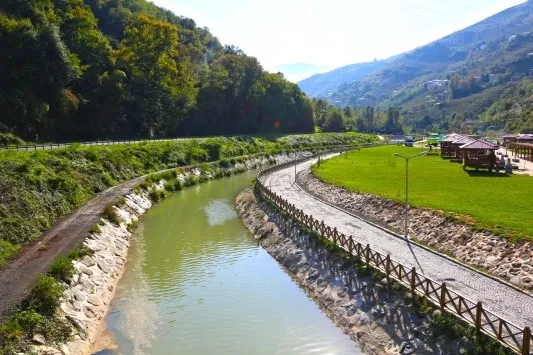
Section selection involves more than enough area to convey a design flow. Width, bank safety, materials, environment and maintenance govern feasibility. Rectangles may suit narrow corridors; trapezoids offer different slopes and widths. Neither is universally superior. Compare alternatives under common flow and site constraints, checking geometry, velocities, transitions and lifecycle needs.
Rectangular geometry
For width b and depth y, A = by and P = b + 2y, with R = A/P. These are free-surface relations, not pressurised-box flow. Vertical walls may save space but require structural and geotechnical design. Narrowing changes velocities and levels. Adequate area alone does not resolve wall height, transitions or maintenance access.
Slope definition in trapezoids
For symmetric side slope z horizontal/vertical, A = y(b + zy), P = b + 2y√(1 + z²), and T = b + 2zy. Reversing the slope convention changes geometry. A hydraulically selected slope does not prove geotechnical stability. Assess lining, soils and groundwater separately; wider or more natural appearance does not establish completed safety or environmental checks.
Comparison at the same discharge
Use common discharges with justified roughness and slopes. Compare normal depth, velocity, perimeter and total height. Different linings may have different n; document this. Equal areas need not have equal hydraulic radius or conveyance: increasing P at fixed A reduces R. Include lining resistance and freeboard rather than compare excavation volumes alone.
Transitions and existing structures
Connections to channels, bridges or culverts can contract, expand or change flow regime. A uniform-reach section may behave differently at transitions. Check bed and wall continuity, losses and direction. Single-section normal-depth calculations omit abrupt turns and width changes; use profiles or 2D where needed. Dimension connections explicitly rather than leave unresolved details to construction.
Choosing for the site and maintenance
Assess corridor, property boundaries, earthworks, materials and cleaning access. Vertical walls and slopes have different access and maintenance needs. Sediment, vegetation and blockage change capacity. Separate existing, proposed and maintained conditions; compare inspection and repair alongside initial quantities. Record the rationale in an alternatives table. Example dimensions are not construction dimensions without site and multidisciplinary checks.
Connecting design with construction and maintenance
A river-rehabilitation assessment does not end with the calculated cross-sectional area. Transitions, existing structures, access, material properties and maintenance requirements are part of the design. Delivery files should distinguish existing conditions from the proposed solution and explain the discharge, geometry, roughness and elevation references used. Identify critical dimensions to check during construction and locations to monitor afterwards. This makes clear how the calculations translate to the site and which changes require a new assessment.
At the initial discussion, share the channel alignment, survey, existing bridge and culvert information, and the planned intervention. Hydraulic adequacy, ground stability, structural design and environmental assessment are different subjects, but their findings affect one another. Compare cleaning, repair and post-flood inspection needs as well as initial construction costs when selecting a solution. Project-specific authority requirements are considered separately. Final dimensions should not be taken from an illustrative calculation or reference table before site data and engineering checks have been completed.
Use the related calculation tool
Sources and related articles
Let's discuss your project's data requirements and reporting scope.
Request a project quote