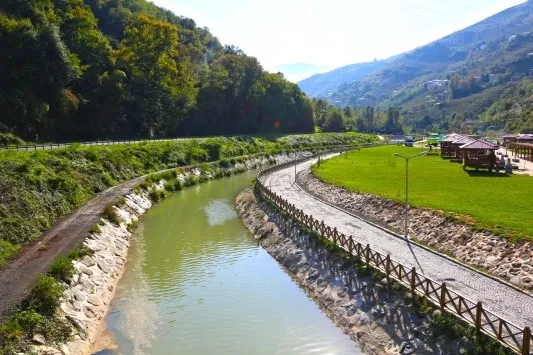
Channels transport sediment as well as water. A section that conveys flow initially may change through deposition or erosion. Initial capacity and long-term bed stability are different assessments. Owners need to understand maintenance and structural effects. Examine supply, grain size, flows and alignment; a fixed-bed hydraulic model does not by itself calculate morphological change.
The logic of sediment continuity
Differences between sediment inflow and outflow can produce storage or bed loss. Greater inflow favours deposition; greater outflow may erode available material. This does not quantify elevation change without grain size, transport mode, porosity and flow history. Catchment erosion and upstream works affect supply. Assess upstream sources and downstream continuity, not velocity alone.
How channel alterations affect the bed
Narrowing, widening, straightening and changing slope alter velocity, depth and shear. Equal conveyance does not mean equal sediment behaviour. Faster flow may erode; slower flow may deposit and reduce capacity. Review local structures and bends. Compare proposals with existing geometry and sediment connections rather than assume capacity improvements also improve stability.
Field and historical information
Collect gradation, bed and bank material, sections, flows, old surveys and interventions. Comparable-datum bed surveys reveal changes; imagery helps identify migration or deposits but does not replace elevations. Separate maintenance and excavation from natural change, and event deposits from long-term trends. Limited evidence warrants explicit ranges and methods, not certainty from one survey.
Model selection and uncertainty
Assessment can range from reconnaissance and continuity checks to transport modelling. Match transport relations to actual materials and flows. Bed mixtures, sediment inflow and initial geometry are uncertain. A software sediment option does not ensure reliable forecasts without data and calibration. Test sensitivity and distinguish fixed-bed hydraulics from evolving-bed results, listing omitted processes.
Maintenance and monitoring
Identify monitoring sections at deposits, scour, piers, culvert entries and protection ends. Repeat sections with consistent references. Base cleaning on measured capacity and structural effects as well as schedules, considering downstream sediment and stability. Explain reassessment triggers to owners. Deliver assumptions, critical locations and maintenance without implying one flood map resolves all bed-change risks.
Connecting design with construction and maintenance
A river-rehabilitation assessment does not end with the calculated cross-sectional area. Transitions, existing structures, access, material properties and maintenance requirements are part of the design. Delivery files should distinguish existing conditions from the proposed solution and explain the discharge, geometry, roughness and elevation references used. Identify critical dimensions to check during construction and locations to monitor afterwards. This makes clear how the calculations translate to the site and which changes require a new assessment.
At the initial discussion, share the channel alignment, survey, existing bridge and culvert information, and the planned intervention. Hydraulic adequacy, ground stability, structural design and environmental assessment are different subjects, but their findings affect one another. Compare cleaning, repair and post-flood inspection needs as well as initial construction costs when selecting a solution. Project-specific authority requirements are considered separately. Final dimensions should not be taken from an illustrative calculation or reference table before site data and engineering checks have been completed.
Sources and related articles
Let's discuss your project's data requirements and reporting scope.
Request a project quote