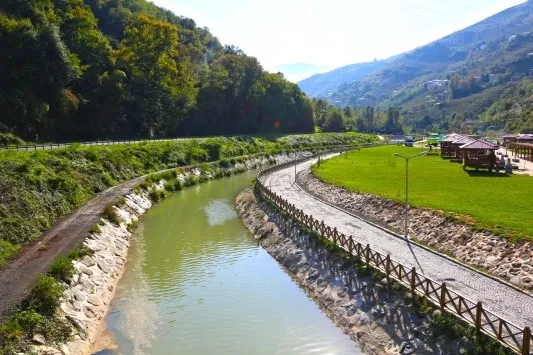
Bank protection should resist hydraulic action while maintaining ground and structure integrity. Riprap, gabions and vegetation are not chosen by appearance or unit cost alone. Velocity, shear, toe scour, soil and maintenance matter. Explain each option's conditions and inspections, including filters, toe support and transitions to unprotected reaches.
Velocity is not the only criterion
Mean velocity alone cannot establish lining resistance. Check shear, turbulence, bends, depth and controls. Flexible-lining design may use permissible tractive force or shear with consistent definitions and units. Structure-local flows may need more than section-average calculations. Do not apply one tabulated velocity limit to all rock sizes, slopes and soils.
Riprap sizing, filters and toes
Define gradation, density, shape, thickness, slope and toe connection together. Filters or geotextiles must retain fine soil while allowing drainage and match soil and cover. Toe scour can undermine otherwise adequate protection. Assess scour and end connections, and specify construction checks for actual stone quality and gradation, not just nominal size.
Gabions and confined-rock solutions
Gabions depend on both stone and wire: assess connections, durability, fill size, foundations and drainage. Basket walls and mattresses differ; distinguish hydraulic lining from retaining-structure stability. Include abrasion, corrosion and damaged-wire maintenance. Ground loss and toe scour remain relevant. Specify construction and inspection rather than assume maintenance-free permanence.
Vegetation and establishment periods
Vegetation can protect suitable surfaces, but establishment needs separate consideration. Species, roots, seasons, inundation and care matter. Mature resistance cannot be assigned immediately to new planting; temporary support may be needed. Vegetation changes roughness, so check protection and capacity together. Natural appearance alone proves neither hydraulic resistance nor environmental suitability.
Alternatives and construction checks
Compare hydraulics, lining, foundation/filter, transitions, maintenance and access. Check erosion at protection ends. Verify elevations, thickness, materials and connections during construction, then inspect toes, filters, wire and vegetation after floods. Sections and soil information support quotation. Determine final sizes from site-specific engineering rather than photographs or catalogue illustrations.
Connecting design with construction and maintenance
A river-rehabilitation assessment does not end with the calculated cross-sectional area. Transitions, existing structures, access, material properties and maintenance requirements are part of the design. Delivery files should distinguish existing conditions from the proposed solution and explain the discharge, geometry, roughness and elevation references used. Identify critical dimensions to check during construction and locations to monitor afterwards. This makes clear how the calculations translate to the site and which changes require a new assessment.
At the initial discussion, share the channel alignment, survey, existing bridge and culvert information, and the planned intervention. Hydraulic adequacy, ground stability, structural design and environmental assessment are different subjects, but their findings affect one another. Compare cleaning, repair and post-flood inspection needs as well as initial construction costs when selecting a solution. Project-specific authority requirements are considered separately. Final dimensions should not be taken from an illustrative calculation or reference table before site data and engineering checks have been completed.
Use the related calculation tool
Sources and related articles
Let's discuss your project's data requirements and reporting scope.
Request a project quote