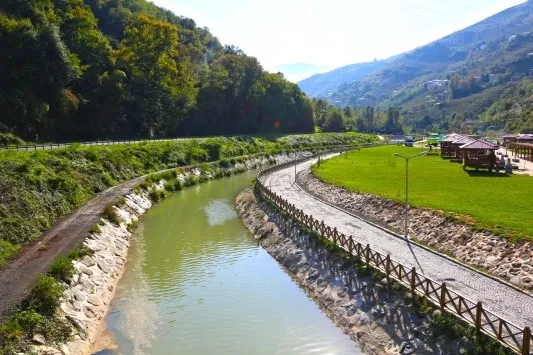
In highway and railway projects, the sizing of bridges and culverts built at points where the road crosses waterbeds is of critical importance in terms of the safety and cost of the project. An incorrectly sized culvert can cause the road to flood or the structure to collapse completely.
What are the Critical Design Criteria?
The sizing of hydraulic structures in infrastructure projects is based on specific steps:
- Determination of Flood Discharge: The return-period discharge selected from values such as Q50, Q100, or Q500 depends on the road class (Highway, State Road, Village Road, etc.), the structure's risk level, and the competent authority's project-specific criteria.
- Determination of Discharge and Water-Surface Profile: Past rainfall data and basin characteristics are used to determine the project's maximum discharge (Qmax); that discharge is then used to calculate the water-surface profile and elevations around the structure.
- Determination of Span and Clearance: Free clearance above the flood elevation and an allowance for debris (tree branches, stones, etc.) are determined by considering the competent authority's project-specific criteria, structure geometry, hydraulic results, and debris risk together. No single minimum value applies to every project.
- Scour Analyses: Bed scour that may occur due to the velocity of water at the bridge piers must be calculated, and the foundation depth must be designed to remain below this scour elevation.
The ArchSu team provides technical support for hydraulic sizing of bridges and culverts, river rehabilitation and channel arrangements at watercourse crossings, and reporting in line with the competent authority's project-specific requests.
Contact us for project-specific hydraulic calculation support for culverts and bridges.
Contact Us